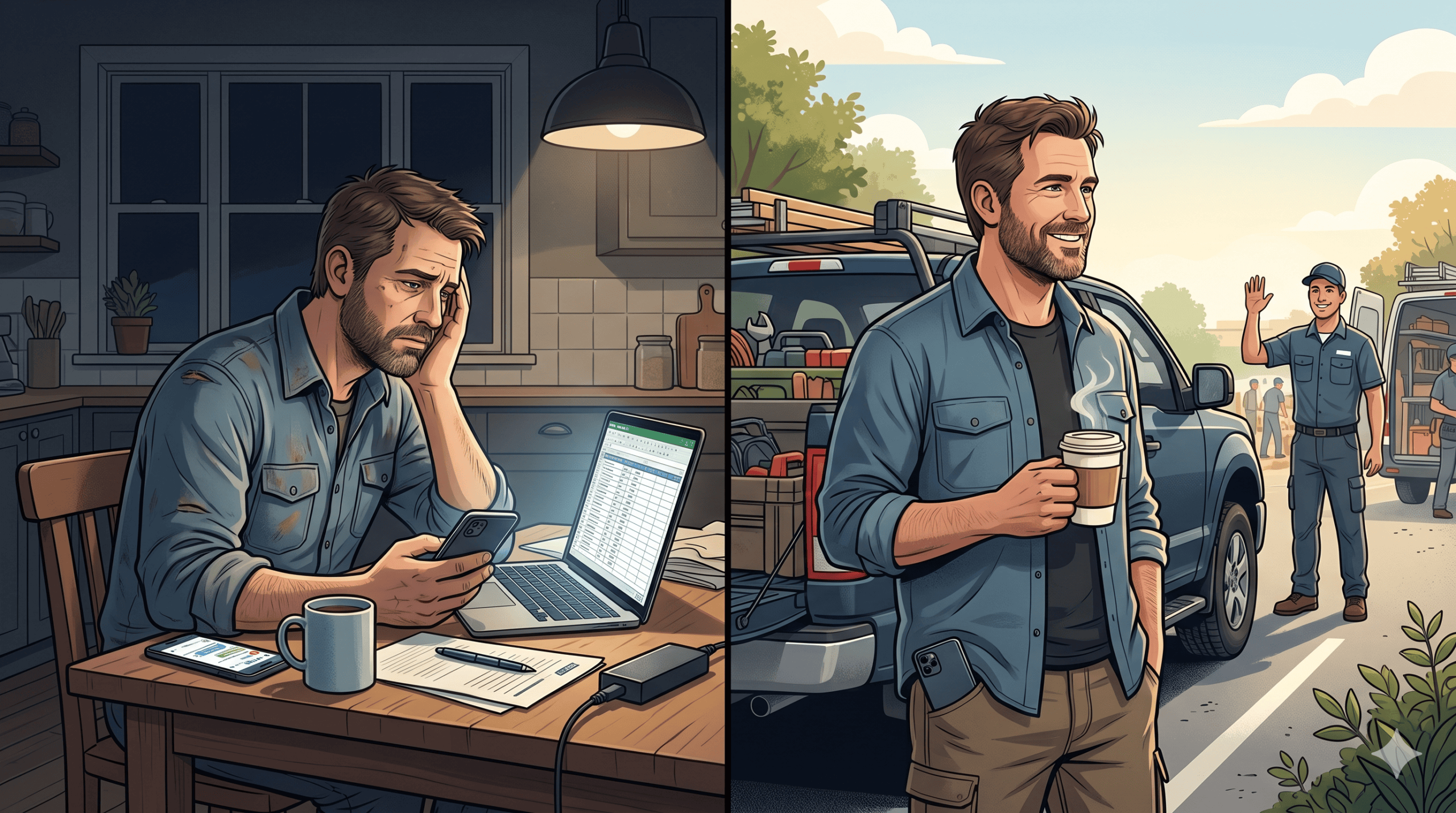

You didn’t start this business to work inside it forever.
You started it because you were good at the work. Because you wanted to build something. Because at some point, the idea of being your own boss meant something — freedom, control, a life that looked the way you wanted it to look.
Somewhere between the first truck and the fifth, that version of the plan got quiet.
Now you wake up to texts before your coffee gets cold. You spend your afternoons putting out fires that have nothing to do with the actual job. And by the time you sit down at the end of the day, the thing waiting for you isn’t rest — it’s the inbox, the invoices, the scheduling problem nobody solved.
You’re not running the business anymore. The business is running you.
The Trap Nobody Warns You About
There’s a trap built into every growing field service business, and almost nobody talks about it.
In the early days, the chaos is manageable because everything runs through you. You know where the trucks are because you put them there. You know what’s outstanding because you wrote it down. You know what’s getting done today because you said so this morning.
But the business grows. And the system doesn’t.
More crew means more calls. More jobs mean more quotes, more invoices, more scheduling decisions. And because the system holding all of it together is still just you — your memory, your phone, your gut — every new truck you add increases the weight on the one person the whole operation can’t function without.
You.
That’s the trap. The harder you work, the more indispensable you become. And the more indispensable you become, the further the original goal gets — the one where the business gave you a life instead of consuming it.
It’s Not a Hustle Problem. It’s a Systems Problem.
Here’s the part most contractors never hear:
The 60-hour week isn’t a sign that you’re not working hard enough. It’s a sign that your business is running on a system that requires a person — you — to hold it together manually, every single day.
The contractors who get their evenings back don’t hustle less. They stop doing manually what a system can do automatically.
They stop calling crew to find out where they are. They stop chasing invoices three weeks after a job. They stop writing quotes on a laptop at midnight. Not because someone else took over — but because the system took over.
That shift doesn’t happen through motivation. It happens through structure.
The 5 Hours That Disappear Every Day Without a System
It doesn’t happen all at once. It’s 20 minutes here, 40 minutes there. By the end of the day, you’ve lost hours you never saw leave. Here’s where they actually go:
The Crew Check-In Loop
“Where’s the crew?” shouldn’t eat 30 minutes of your morning. But when the only way to know is to call, that’s exactly what happens — and it happens every day. The calls lead to voicemails, the voicemails lead to texts, the texts lead to miscommunication. Real-time visibility on every truck removes this loop entirely.
The Quote That Waited Until Tonight
A client called at 2 PM. You were on a job site. By the time you got back to it, it was 9 PM — Excel open, kitchen table, alone. A quote that takes 90 seconds to send from your phone is a quote that doesn’t follow you home. That’s not a small thing. That’s an evening back.
The Timesheet That Nobody Remembers Correctly
When crew logs hours by text or paper, you end up reconciling memory at the end of the week. Disputed hours, missing hours, rounded-up hours. Automatic clock-in from a phone takes 3 seconds and removes the conversation entirely. The time goes where it actually belongs — without you in the middle of it.
The Follow-Up Nobody Did
A lead came in on Tuesday. You were going to call back Thursday. It’s now Monday and you’re not sure if anyone followed up. When lead follow-up depends on someone remembering to do it, it happens inconsistently. When it’s automated — a message goes out, a reminder triggers, the lead stays warm — it happens every time, whether you’re on a roof or at dinner.
The Invoice That Left Late — or Didn’t Leave at All
The job was done on Friday. The invoice went out Wednesday. Or didn’t. Every day between completed work and sent invoice is a day your cash flow waits for something that should have been automatic. Billing that connects directly to job completion doesn’t need a reminder. It just goes out.
What the Contractors Who’ve Already Done This Look Like
They’re not running smaller operations. Most of them are running bigger ones.
The difference isn’t the size of the business. It’s that the business no longer requires them to be physically present in every decision, every communication, every task for things to keep moving.
They know where every truck is before they’ve had breakfast. Quotes go out while they’re still at the job site. Timesheets close automatically. Invoices send when the work is marked done. And at 5 PM, they leave.
Not because they stopped caring about the business. Because they built it so it doesn’t need them to manually hold it together every hour of every day.
That’s the version of this industry that’s coming — the one where the contractors who automated the right things early are running more jobs, with less chaos, and actually taking a Sunday off.
The window to close that gap before it becomes permanent is now.
The System That Runs When You Don’t
The reason most field service contractors try a new tool and go back to WhatsApp is simple: the tool wasn’t built for them.
It was built for a marketing team inside a tech company. Wrong language. Wrong problems. Wrong workflow.
What actually works for a field service business is a single platform built around the way that business actually runs — one that handles quoting, billing, crew tracking, fleet GPS, time logging, and communications in one place, with no complicated setup, and no five-app juggling act holding the whole thing together.
Not configured by you. Configured for you — so you keep running the business while it gets built around it.
The Original Goal Is Still Available to You
The 60-hour week was never the goal. It was the cost of a system that hasn’t caught up yet.
The contractors who’ve changed that aren’t exceptional. They didn’t invent a new way to work. They just stopped doing manually what didn’t need to be manual — and used the time they got back to actually run the business they built.
There’s a version of your business that exists where you leave the job site by 5. Where the crew runs the day without you as the dispatcher. Where the invoices go out before you get home.
That version isn’t luck. It isn’t a bigger team. It isn’t more hustle.
It’s the system.